
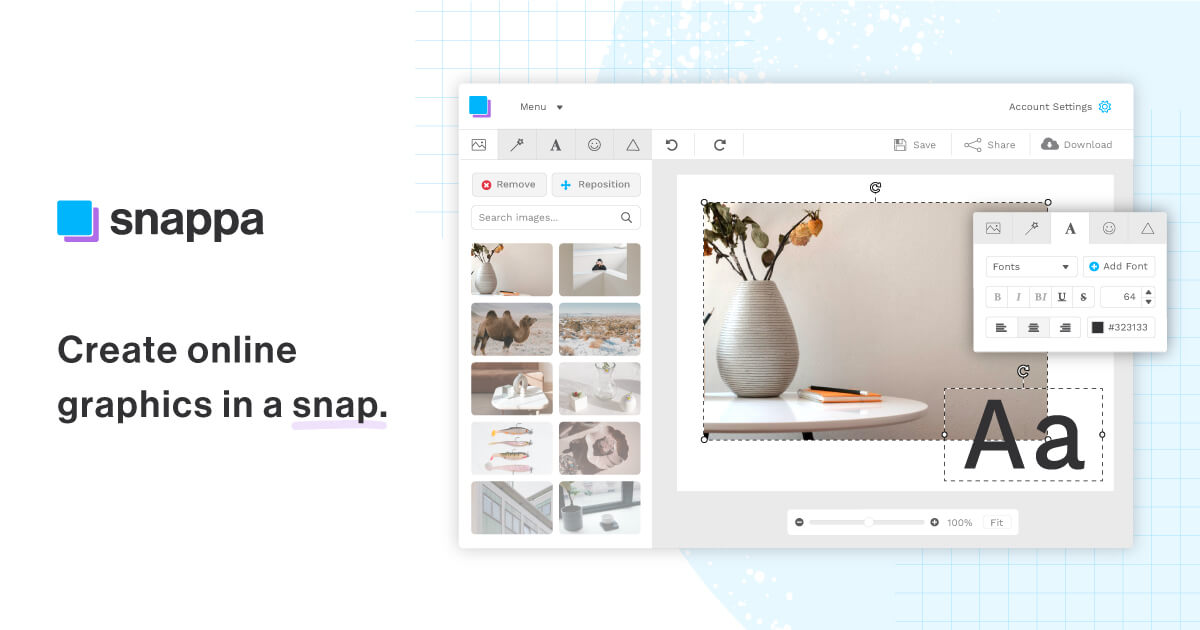
Snappa Pricing, Features & Alternatives | SmartBizTools
Graphic Design · Freemium

Snappa

Snappa is a Graphic Design tool for teams that want to improve creating branded visuals quickly. Compare pricing, features, pros, cons, and alternatives.

Brand Identity Graphic Design Video Production
SmartBizTools Score
0/5
Graphic Design
4.3/5 Score
Freemium Pricing
Graphic Design Category

Features & Use Cases

Key Features
  • Design templates
  • Brand kits or style controls
  • Social media asset creation
  • Collaboration and exports
  • Stock elements and icons
  • AI-assisted design tools when available
Primary Use Cases
  • Brand Identity
  • Graphic Design
  • Video Production

Pros & Cons

✅ Strengths
  • Enables fast visual asset production
  • Great for repeatable marketing formats
  • Templates reduce design bottlenecks
  • Useful for non-designers and small teams
  • Can maintain consistent brand assets when set up well
⚠️ Tradeoffs
  • Template-heavy output can look generic
  • Advanced brand systems still need design oversight
  • Teams may need asset governance to avoid inconsistency
  • Some premium assets require paid plans
  • Not always a replacement for professional design software

Full Review

Snappa review cover image for Graphic Design
Snappa review, pricing, features, pros, cons, and alternatives for business users.

Snappa Review: Is It Worth Using?

Snappa is best understood as a graphic design and visual content platform. In the Smart Business Tools directory, it sits in the Graphic Design category and is most relevant for Brand Identity, Graphic Design, Video Production. This review replaces the generic placeholder description with a practical buying guide for teams that want to know where Snappa fits, when it is worth paying for, and what to compare before choosing it.

The short answer: Snappa is worth evaluating when your team needs help with creating branded visuals quickly, using templates for campaigns, or supporting social, ads, presentations, and documents. Its listed starting price is Free / $15/mo (Pro), and its SmartBizTools rating is 4.3/5. You should still confirm the latest plan limits and pricing on the official vendor site before purchasing because software pricing and feature availability can change.

For broader discovery, you can also browse our AI tools directory, compare more options in the AI tool comparison hub, or explore similar tools in Graphic Design.

Quick Verdict

Snappa is a strong option for marketers, founders, social media managers, agencies, and non-design teams that want a practical way to improve creating branded visuals quickly. It is not just another tool to add to the stack; its value depends on whether it removes a real bottleneck in your existing workflow. If your current process is slow, manual, inconsistent, or too dependent on one specialist, Snappa can be worth testing.

Primary categoryGraphic Design
Best fitTeams that need frequent, good-looking marketing visuals without waiting on a dedicated designer for every asset.
Starting price listedFree / $15/mo (Pro)
SmartBizTools rating4.3/5
Main buying reasonCreating branded visuals quickly
Watch-outTemplate-heavy output can look generic

Who Snappa Is Best For

Snappa is most useful for users who already have a repeatable workflow and need a faster, cleaner, or more scalable way to execute it. It is especially relevant for teams working in Brand Identity, Graphic Design, Video Production and businesses in areas such as Ecommerce, Marketing, Media.

  • Small business owners who need practical software that produces measurable time savings.
  • Marketing and content teams that want faster output without losing quality control.
  • Freelancers and agencies that need repeatable workflows, client-ready outputs, and clearer delivery systems.
  • Growing teams that want a tool they can adopt now and expand later if the workflow proves valuable.

Key Features

The most important features are not just the longest checklist items. They are the functions that directly affect speed, quality, and repeatability. For Snappa, the feature set should be judged around how well it supports real business use rather than how impressive it looks on a pricing page.

  • Design templates
  • Brand kits or style controls
  • Social media asset creation
  • Collaboration and exports
  • Stock elements and icons
  • AI-assisted design tools when available

Strengths

The main advantage of Snappa is that it gives users a clearer path from task to output. Instead of forcing teams to build every process manually, it can help standardize the work and reduce friction. This is especially valuable when a team repeats the same type of task every week.

  • Enables fast visual asset production
  • Great for repeatable marketing formats
  • Templates reduce design bottlenecks
  • Useful for non-designers and small teams
  • Can maintain consistent brand assets when set up well

Limitations

No business tool is a perfect fit for every workflow. Snappa should be tested against your actual process, not evaluated only from screenshots or feature lists. Pay attention to setup effort, plan limits, collaboration needs, export options, and whether the team will actually use it after the first week.

  • Template-heavy output can look generic
  • Advanced brand systems still need design oversight
  • Teams may need asset governance to avoid inconsistency
  • Some premium assets require paid plans
  • Not always a replacement for professional design software

Pricing Notes

The pricing listed in this directory is Free / $15/mo (Pro). Treat this as a starting point for evaluation, not a final quote. Before committing, check whether the plan includes the limits your team needs, such as seats, exports, credits, storage, automation volume, integrations, analytics, or commercial usage rights.

A good pricing test is simple: estimate how many hours Snappa could save each month, multiply that by your internal hourly cost, and compare the result with the monthly subscription. If the tool does not save time, improve quality, increase revenue, or reduce operational risk, it may not be worth upgrading yet.

Best Use Cases

Snappa is strongest when it is attached to a specific job rather than used vaguely. The best implementation starts with one workflow, one owner, and one measurable outcome.

  • Primary workflow: Creating branded visuals quickly.
  • Secondary workflow: Using templates for campaigns.
  • Team workflow: Supporting social, ads, presentations, and documents.
  • Scaling workflow: Reducing dependence on designers for routine assets.

How to Evaluate Snappa

Do not evaluate Snappa by signing up and clicking around randomly. Use a small test project that represents the work you do every week. That makes the result easier to judge and prevents the team from being distracted by features that look useful but do not affect business outcomes.

  1. Choose one recurring workflow that currently wastes time or creates inconsistent output.
  2. Run the same workflow using your current process and then using Snappa.
  3. Compare time saved, output quality, review effort, and team adoption.
  4. Check whether the tool integrates with the systems your team already uses.
  5. Only upgrade if the tool improves the workflow enough to justify the cost.

Alternatives and Internal Comparisons

If Snappa is close but not a perfect fit, compare it with similar tools before committing. Relevant alternatives in the Smart Business Tools directory include Canva, Visme, Crello, and VistaCreate. These internal comparisons help you avoid choosing a tool only because it is popular; the better choice is the one that fits your workflow, budget, and team maturity.

SEO and Business Value

From a business-growth perspective, Snappa is most valuable when it contributes to a measurable outcome: faster publishing, better customer communication, cleaner operations, more reliable reporting, higher conversion rates, or reduced manual work. A tool page or software subscription is not valuable by itself; the value comes from a repeatable process that your team can maintain.

For SEO-driven teams, the best approach is to connect Snappa to a content or operations workflow with clear internal links, search intent, and conversion goals. For example, if you use it to support content production, link the resulting pages to relevant tool reviews, category hubs, and comparison pages so users can keep exploring your site. Start with the main AI tools hub and related Graphic Design tools category page.

Final Recommendation

Snappa is a good candidate if you can name the exact workflow it will improve. It is less compelling if you are simply collecting tools without a clear use case. Start with a short trial, test one repeatable project, and decide based on speed, quality, adoption, and return on effort.

Bottom line: choose Snappa if its strengths match a real bottleneck in your business. Compare it with related tools, confirm pricing on the vendor site, and keep the evaluation focused on outcomes rather than feature count.

Frequently Asked Questions

What is Snappa used for?

Snappa is used for creating branded visuals quickly, using templates for campaigns, and related workflows in the Graphic Design category.

Is Snappa good for small businesses?

Yes, Snappa can be useful for small businesses if it solves a specific workflow problem and the starting plan fits the budget. Small teams should test it on one recurring process before rolling it out broadly.

How much does Snappa cost?

The pricing listed in this directory is Free / $15/mo (Pro). Always verify the latest pricing and plan limits directly with the vendor before buying.

What are the best alternatives to Snappa?

Good alternatives depend on your use case. Start by reviewing similar options such as Canva, Visme, Crello, and VistaCreate, then compare pricing, workflow fit, integrations, and team adoption.

Ready to try Snappa?

Visit the official site to explore plans, demos & free options.

Try Snappa →
Visit Snappa